
News In BriefGuest FacilitiesNewsHoliday Parks
New sensory room at Discovery Parks – Goolwa to help shape future inclusive tourism
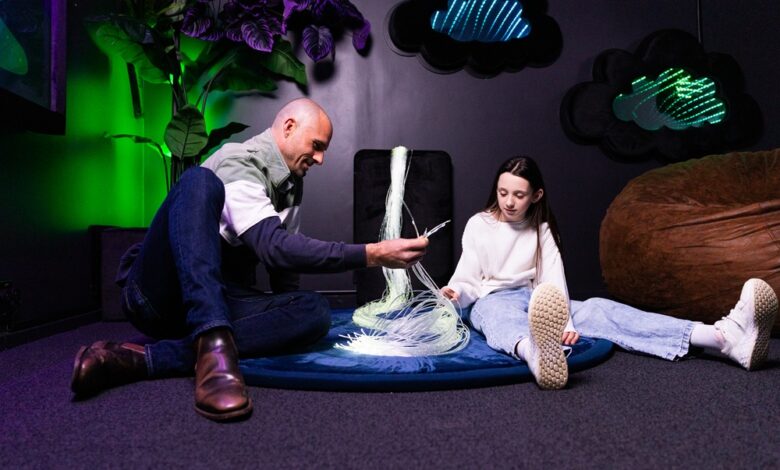
The space will be an inclusive space for families, and form part of a research project to help shape the future of accessible tourism.

A new sensory room at Discovery Parks – Goolwa will create an inclusive new space for holidaying families, and also gather vital feedback as part of a 12-month research project to help shape the future of inclusive tourism.
As families prepare for the summer school holiday rush, Discovery Parks – Goolwa has opened the new sensory regulation space to give people of all ages a quiet place to reset when the sights, sounds and activity of a holiday become too much.
The new space has been designed using evidence-based sensory principles to help reduce stress, lower cognitive load and support nervous system regulation, with the aim of helping people return to enjoying their holiday rather than needing to leave altogether.
It is also the starting point for a new 12-month research study into sensory regulation in holiday environments.
Discovery Parks is inviting guests, local families, carers and individuals across the Fleurieu Peninsula to take part and share their experiences. The findings will be used to better understand what works and help inform more inclusive holiday experiences across the tourism industry.
Research from Autism Spectrum Australia (Aspect) found that sensory overload, uncertainty and anxiety make travel significantly more stressful for families with sensory-sensitive members – with some avoiding it altogether.
For Scott, whose daughter is diagnosed with autism, having somewhere to retreat when things become overwhelming could make the difference between a stressful holiday and one the whole family can enjoy.
“We’re constantly thinking about contingency plans for if it gets too much, what we can and can’t do and the impact on her,” Scott said. “We have even cancelled trips due to the anxiety it’s created. Knowing there’s somewhere we can go to reset within the holiday park is a gamechanger for us.”
Dr Cavanagh said the philosophy behind the space is simple: the environment should do the work.
“The environment has been designed to reduce cognitive load, gently guide attention and support nervous system regulation,” she said. “When people are able to regulate and recover from sensory overwhelm, they’re often able to re-engage with the broader venue experience rather than needing to leave altogether.”
Discovery Parks’ Interim Chief Operating Officer Michaela Webster said the initiative builds on the pioneering work of the Watts family’s Reilly Room project and marks the next step in making holidays more accessible for families who can find travel challenging.
“Families shouldn’t have to hope for the best when they go on holiday,” she said. “We’ve created this space with experts who understand sensory regulation, and now we want to understand what happens when you put those principles into a real holiday environment.
“While Discovery Parks are well known for water parks and kids’ clubs, this new approach is centred on nervous system regulation, helping people recover from sensory overwhelm in as little as 10 minutes, without the need for clinical support or a trained worker.
“Over the next 12 months, we’ll be listening to families and gathering evidence about what genuinely helps people regulate while travelling and look to expand the spaces across our parks.”
The Goolwa sensory space is part of the park’s broader $20 million redevelopment and will be available to guests and the local community. Families and individuals interested in participating in the 12-month study can register their interest through Discovery Parks – Goolwa.
Meet us at NoVacancy
AccomNews Editor Gemma Harling and the team will be at NoVacancy, Australia’s leading hotel and accommodation industry event, on September 23 and 24 at ICC Sydney.
Visit the AccomNews team at Stand 708 to pick up the latest issue, have a chat and discuss industry news, editorial opportunities and advertising.