
More than shade: Turning outdoor spaces into guest destinations
Finding the right shade solutions can transform your outdoor areas into spaces guests actually want to spend time in

Whether it’s a pool deck, rooftop bar, restaurant terrace, guest courtyard or communal recreation area, guests increasingly expect these spaces to be comfortable, functional and usable throughout the year, not just during perfect weather.
As operators continue looking for ways to improve guest experiences and maximise the return on existing assets, commercial shade solutions are playing a bigger role than ever. According to Justin Brass of Skyspan Shade, one of the biggest mistakes operators make is judging an umbrella solely on purchase price rather than its long-term value.
“Accommodation operators should be looking beyond the initial cost and considering how the product will perform over many years in a commercial environment,” he says.
The latest print edition of AccomNews is out now. Read it HERE
Durability has become a major consideration, particularly as many businesses look to align purchasing decisions with broader sustainability goals. Products that can be refurbished, repaired and eventually recycled are increasingly attractive compared with disposable alternatives.
That starts with the materials.
Commercial umbrellas should be constructed from high-quality materials, including rust-resistant frames, UV- resistant canopy fabrics and sturdy support systems capable of handling the demands of busy hospitality environments.
The choice of canopy fabric is particularly important. “The canopy is the hardest working component of any umbrella,” Justin explains. “It needs to provide excellent UV protection, be water resistant and resist mould and mildew while maintaining its appearance over time.”
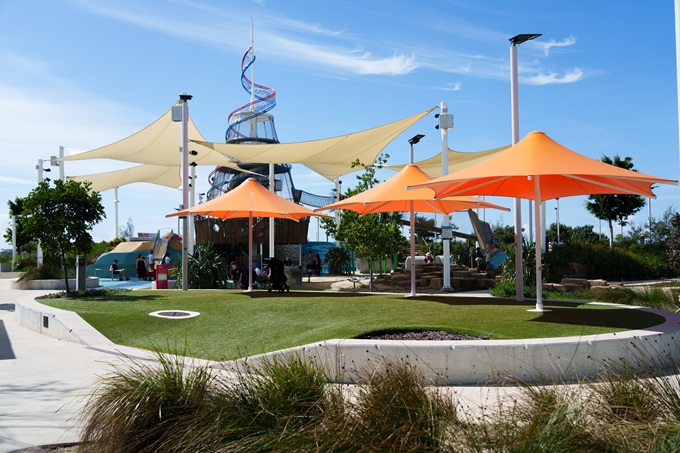
For larger properties, operators are also looking beyond single umbrella installations. Linked umbrella systems are becoming increasingly popular because they can create continuous areas of shade and rain protection across larger outdoor spaces while maintaining a cohesive appearance.
For resorts, holiday parks and apartment hotels, this can be particularly useful around pools, outdoor dining areas, event spaces and communal guest facilities where uninterrupted coverage is often preferred.
Longevity driving design decisions
One of the strongest trends Justin is seeing across the hospitality sector is a growing focus on product longevity.
After years of testing fabrics in commercial and industrial environments, fabric engineers recommend architectural-grade PVC for permanent commercial umbrella installations because of its durability and long-term performance. Justin said businesses should look for shade products that are made in Australia, and built to withstand Australia’s harsh conditions.
Related AccomNews article: Outstanding outdoor areas: How these spaces boost guest enjoyment
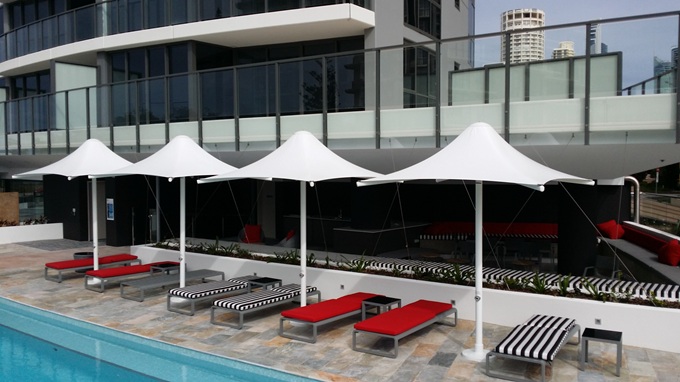
At the same time, guest expectations are influencing design choices. Poolside spaces, in particular,
are increasingly moving towards cantilever umbrella designs. By removing the centre pole, cantilever systems create greater flexibility beneath the canopy and maximise usable space around sun lounges, outdoor dining settings and recreation areas.
However, appearance should never come at the expense of structural performance. “Commercial cantilever
umbrellas need to be structurally engineered to withstand a range of weather conditions,” Justin says. “It’s
also important that they can be safely wound away during significant weather events.”
Understanding wind ratings
For operators in coastal destinations and other high wind locations, structural performance should be one of the first considerations, not an afterthought. Looking beyond appearance and price, Justin says operators need to understand how an umbrella has been engineered to perform in a demanding commercial environment.
One of the biggest misconceptions in the market is the assumption that all wind ratings are the same. In reality, there can be a significant difference between an engineered wind rating and a wind tunnel test rating. “It’s important to compare apples with apples,” Justin says.
Understanding the engineering behind a product is critical when evaluating long-term value. While two umbrellas may appear similar on paper, differences in structural design, materials and testing standards can have a significant impact on performance, maintenance requirements and lifespan.
“An engineered wind rating means the umbrella has been structurally designed to withstand the stated wind conditions and speeds. A wind tunnel tested rating is often simply the point at which the umbrella fails.”
The distinction can have major implications when evaluating products for long-term commercial use. For accommodation providers in exposed coastal locations, engineering specifications can ultimately determine whether a shade solution delivers years of reliable performance or becomes an ongoing maintenance issue.
Installation is another critical factor. Permanent commercial umbrellas often require inground footings and specialist installation. Existing decks may also need reinforcement to support the structure and ensure structural stability over time.
While these considerations may not be the most exciting part of a project, they are often the difference between a shade solution that performs reliably for years and one that becomes a maintenance headache.
The maintenance factor
For accommodation operators, ongoing maintenance is another consideration that is often overlooked during the purchasing process.
Commercial umbrellas are exposed to constant use, weather and environmental conditions, so the ability to service and maintain them easily can significantly influence their lifecycle value. Justin recommends looking
for products with replaceable components, removable canopies and robust construction methods that allow individual parts to be repaired or replaced rather than requiring a complete replacement.
Ease of operation is equally important. Opening, closing and rotating mechanisms should be reliable and straightforward for staff to use, while secure locking systems can help prevent tampering and unnecessary wear.
It’s not just about blocking the sun
Shade structures are often viewed primarily as functional additions, but Justin says they can also play an essential role in shaping the guest experience.
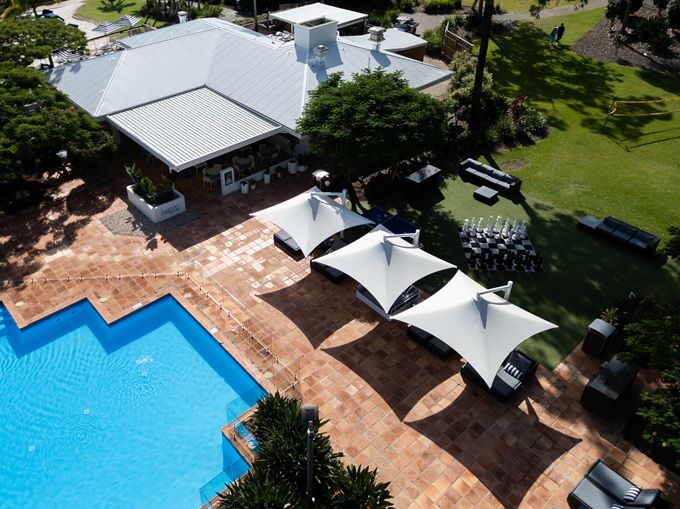
Outdoor umbrellas contribute significantly to the overall appearance of a space and should complement the property’s architecture, landscaping and furniture selection. Customisation options, including canopy colours, logos and branding elements, can also help strengthen a property’s identity and create a more memorable environment for guests.
Read more Property stories on AccomNews HERE
Justin also encourages operators to work with manufacturers that can tailor a solution to the property’s specific requirements rather than adopting a one-size-fits-all approach.
Every property is different. A beachfront resort, a regional holiday park and a city apartment hotel will all have different operational needs, environmental conditions and guest expectations.
Colour with purpose
Interestingly, colour selection can influence more than aesthetics. Each canopy colour offers a different balance of solar transmission, solar reflection and solar absorption, which affects the comfort and ambience created beneath the structure.
For warmer climates, lighter colours such as white, champagne and vanilla can provide higher levels of solar reflection, creating a cooler under-canopy environment. On the other hand, brighter colours such as orange, poppy and buttercup allow greater light transmission, creating a brighter and more vibrant atmosphere underneath.
“It’s something many people don’t consider initially,” Justin says, “but canopy colour can have a real impact on how guests experience a space.”
Making outdoor spaces work harder
As accommodation businesses continue searching for ways to increase guest satisfaction without major redevelopment projects, outdoor areas represent an opportunity that is often hiding in plain sight. A well-designed shade solution can transform a space that is uncomfortable during parts of the day into an area guests actively choose to use.
By providing protection from both sun and rain, operators can extend the usability of outdoor spaces, encourage longer guest dwell times and create more opportunities for dining, relaxing and socialising outdoors.
Perhaps most importantly, commercial umbrellas offer flexibility that fixed structures often cannot. Spaces can be adapted for seasonal demand, events and changing operational needs without permanently altering the environment.
For accommodation providers, that flexibility can deliver benefits well beyond shade alone. After all, the most successful outdoor spaces aren’t simply the ones that look good. They’re the ones guests want to spend time in.
This article first appeared in the Winter edition of AccomNews. Click below to explore.