

Hotel occupancy mid-year report card: A tale of two quarters
AA CEO James Goodwin says geopolitical uncertainty, higher fuel costs, and softer economic conditions continue to impact the sector.

Accommodation Australia has released its annual 2026 Hotel Occupancy Mid-Year Report Card. It shows the hotel market started the year strongly but was hampered by external forces through the second quarter.
Accommodation Australia CEO James Goodwin said major events helped drive demand and room rates early in the year, but geopolitical uncertainty, higher fuel costs, and softer economic conditions weighed on performance as the year progressed.
The latest print edition of AccomNews is out now. Read it HERE
“The figures show that the first half of the year has really been a tale of two quarters,” said Mr Goodwin. “The industry entered 2026 with strong momentum, but is now navigating a more uncertain environment –
especially internationally.
“National occupancy across the full six months was up only 0.9%, with the rise in the average daily rate
barely keeping up with inflation.
“South Australia was the strongest-performing market, with occupancy up 2.5% and average daily rate up 6.2%. New South Wales, Queensland, and Victoria all delivered steady growth across occupancy and average room rate, while Western Australia recorded solid six-month results despite softer conditions emerging in the second quarter.
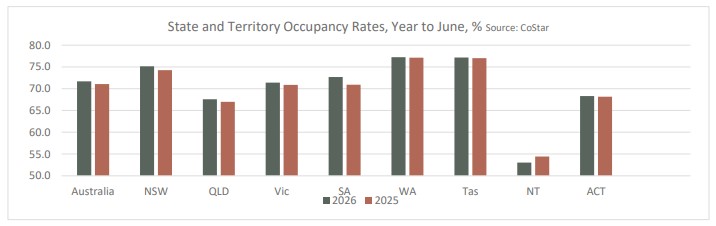
“Some of the moderation we are seeing is the normal seasonal transition into winter, but some markets are facing additional pressures from the uncertainty in the Middle East, fuel costs, inflation and softer consumer confidence. The key question for the second half of the year is whether the gap between the strongest and weakest markets will narrow.”
Mr Goodwin said Sydney remained the strongest-performing capital in the first half of the year. “Although Sydney only saw average occupancy increase slightly from 79.0% to 80.3%, the average rate rose faster than inflation – 7.3% – to $283.36,” he said. “Major events including the New Year’s Ashes Test, Mardi Gras and Vivid Sydney helped sustain demand across the first half of 2026.”
Related AccomNews story: End of a strong first half
Mr Goodwin said the second quarter saw moderation across most markets as trading moved from the summer peak into the quieter autumn and winter period – and international uncertainty continued. “Hobart, Melbourne and Sydney recorded the largest quarter-on-quarter ADR declines after particularly strong first-quarter results, although each remained above or broadly in-line with the same period last year.”
“Brisbane and Canberra were the two markets where conditions remained softer. Brisbane’s ADR was up 2.8% year-on-year to $241.20 in the first quarter but fell 2.7% year-on-year to $198.10 in the second quarter. Canberra was the only capital city where ADR declined across both quarters compared with 2025.”
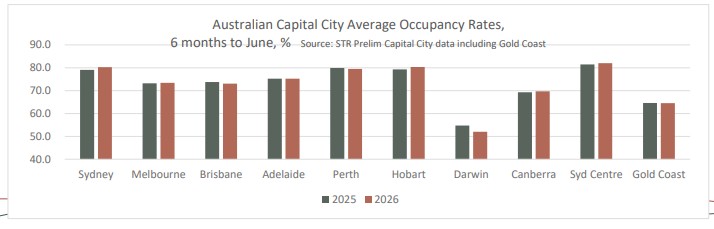
Mr Goodwin said higher aviation costs and reduced flight capacity continued to affect some destinations, particularly the Northern Territory. “The NT has felt these pressures most acutely, with reduced capacity on some Darwin routes contributing to softer demand. Darwin’s occupancy declined 2.7 percentage points for the half, the steepest decline of any capital city, even though operators there have still managed to increase rates.”
Early figures point towards a weak second half of 2026. “Early figures for July indicate conditions continue to worsen in the hotel market, with occupancy in the month to 25 July only rising in two cities – Sydney and Hobart – compared to the corresponding period in July 2025. Adelaide and Darwin experienced the largest occupancy declines “- both down 5.1%.”
Accommodation Australia, the nation’s peak accommodation body, will release its full-year hotel report card in early 2027.