
How will Australian and New Zealand hotels perform in 2026?
Exclusive: Ross Beardsell unpacks the results, regional contrasts, and key takeaways from JLL’s latest survey — offering an inside look at what’s keeping hoteliers awake at night and what’s driving confidence for the year ahead.

Costs and economic uncertainty are clouds on the horizon for Australian and New Zealand hoteliers, however the 2026 JLL Hotel Operators’ Sentiment Survey reveals that the industry is generally optimistic about the year ahead.
What keeps hoteliers up at night as they contemplate the year ahead? Interestingly, Australian hoteliers have a very different view to their counterparts elsewhere in Asia Pacific.
Read the latest edition of AccomNews HERE
The JLL Hotel Operators’ Sentiment Survey 2025/26 was based on 832 responses from hotels across 22 countries in Asia Pacific.
Overall, Australian hoteliers were optimistic about performance in 2026, with only 14 percent of Australasia GMs expecting conditions in 2026 to worsen. That’s an improvement from a negative sentiment of 25 percent in 2025, and 44 percent in 2024. Among Asia-Pacific regions, Greater China hoteliers are the most pessimistic, while Japan/South Korea and South Asia/India are the most optimistic.
The majority of markets in APAC are expecting two – five percent GOP growth, though China continues to be the outlier on sentiment.
Understandably, geopolitical tensions such as tariffs and trade are of far greater concern to Asian hoteliers, whereas Australian and New Zealand hotelier respondents identified cost inflation, labour cost increases, an economic slowdown, increased competition, and a reduction in corporate travel as the five top constraining factors.
Almost nine out of ten Australian respondents anticipate revenue growth in 2026, led mainly by higher ADR.
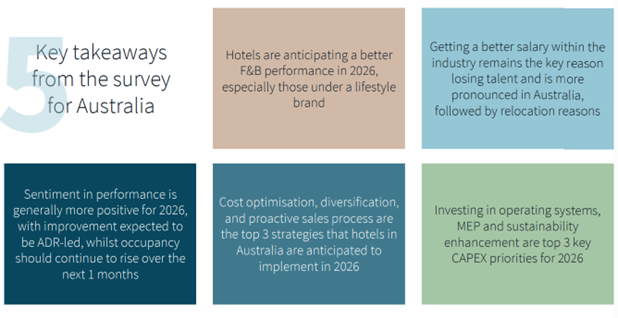
One of the key drivers of ADR growth is an anticipated boost in F&B performance, especially for hotels under a lifestyle brand. This confidence was based on forecasts of interest rate easing and increases in household discretionary income, which might not materialise given the latest inflation figures.
Still, 72 percent of respondents were positive about F&B revenue growth in 2026, and 69 percent were positive about F&B profit growth.
And there’s solid grounds for optimism. Lifestyle hotels have dominated hotel growth over recent years. In Sydney, new brands such as Caption by Hyatt, 25Hours and TFE’s The Eve have placed greater emphasis on their F&B outlets. Even ‘classic’ hotels such as Sofitel Wentworth have jumped on the trend, outsourcing their F&B to specialist hospitality providers. The newly branded InterContinental Coogee Beach will reopen with a Rick Stein restaurant, with more than 200 seats to boost covers and yield.
In Melbourne and Brisbane, there’s been a similar trend, and even in resort areas such as the Sunshine Coast, the Sofitel Noosa Resort will rebrand as Elysium Noosa Resort in December, with Melbourne restaurateurs Alessandro and Anna Pavoni taking their Italian dining experience, Cibaria, to Hastings Street.
However, it is not all wine and roses on the F&B front. Hoteliers identified cost pressures, inflation, and labour and skills shortages as major issues. Product innovation and differentiated food and beverage offerings, along with technology and efficiency gains and improved conference and events profitability were identified as priorities for the year ahead.
Despite hotel companies’ efforts to retain and develop their staffing resources, hotels are still facing severe labour challenges. The rapid increase in hotels and the reduction in working visas have exacerbated a problem that has now become chronic.
Remuneration is at the heart of the problem. “Better salary outside of the industry” was a significant reason for staff turnover, but “Better salary within the industry” was an even bigger issue, as new hotels enticed staff away from existing hotels, despite HR teams’ efforts to improve conditions and culture. Relocation was also cited as a reason for losing staff, highlighting the mobility of Australian hospitality workers, coupled with team members moving to regions with more affordable cost of living.
At a property level, unlike the great property space saver, Dr Jerry Schwartz, few hoteliers indicated that they would be looking to repurpose existing spaces to make them more profitable. Instead, the emphasis for CAPEX spend in 2026 would be on upgrading operational systems and service tools, as well as mechanical, electrical, and plant projects.
Sentiment on sustainability suggests a divergence between clients who want more proactive sustainability initiatives and owners who are not convinced of the ROI. Caught in the middle are hotel management companies with strict sustainability standards. However, stricter Client Procurement Policies for corporate and conference travel may make it more imperative for hotels to action sustainability accreditation if they are to avoid losing business to competitors.
Key takeaways from the JLL Hotel Operators Sentiment Survey