

Wageflation widening the gap between sectors and regions
Casuals feeling the crunch: Higher wages, less hours signal job insecurity, unpredictable pay...

Employment Hero’s August SmartMatch Employment Report reveals a growing divide in Australia’s economy, where rising wages and shrinking hours are creating challenges for businesses across sectors and regions.
Despite a 6.2 percent annual moving average wage uptick in wages, productivity is suffering as businesses struggle to balance wageflation in August, with 2.4 percent fewer median monthly working hours in a bid to retain staff. This persistent wageflation is fuelling a hotter-than-reported jobs market, with verified wage growth among SMEs sitting well above the ABS wage growth figure of 4.1 percent reported in June.
This trend was particularly pronounced in August casual employment, where a 9.8 percent rise in jobs was coupled with a 4.9 percent decline in hours worked, signalling growing job insecurity as employers grapple with the pressures of ‘wageflation’ while trying to stay afloat.
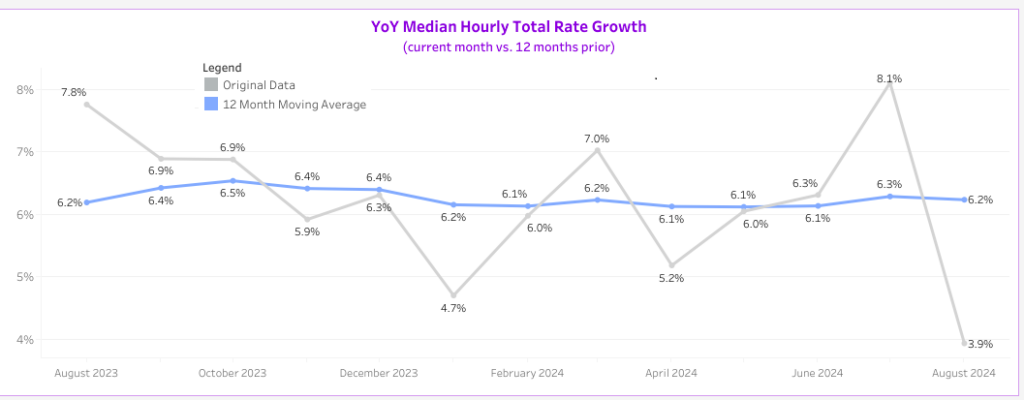
The report is drawn from verified, aggregated real-time employment data from over 2 million employees and 300,000 businesses that are served by the Employment Hero platform globally. The figures are broken down by state, industry, age and employment type.
Wageflation sparking productivity concerns and “labour hoarding”
While wage growth is generally positive, the reduction in hours worked raises red flags. Businesses are grappling with balancing rising wages against declining productivity, with last quarter’s GDP indicating productivity per hour dropped 0.8 percent while the average unit cost of labour increased by 1.3 percent. As the RBA pointed out in recent commentary, inflationary pressures continue to build as the job market remains strong, despite the cutback in hours. This dynamic is contributing to “wageflation”, where wage increases outstrip economic output, adding fuel to inflation without corresponding productivity gains.
Small and medium-sized enterprises (SMEs) are bearing the brunt of rising wages, lopping employee hours despite the additional strain on their operations. This behaviour is an indicator of “labour hoarding” where businesses are desperately trying to retain staff in anticipation of future labour shortages and the sting of the cost of recruitment.
Regional and sectoral disparities: Australia’s two-speed economy
Australia’s recovery remains uneven across regions and sectors. The ACT led the nation with wage growth of 6.9 percent, while South Australia lagged behind at 2.6 percent, illustrating the stark contrasts in economic performance.
Meanwhile, sectors like Construction & Trade Services saw significant wage increases of 9.8 percent, while Healthcare & Community Services lagged at 3.7 percent, highlighting disparities in wage growth across industries. Annual employment growth continues to remain the highest in WA at 7.2 percent and QLD at 5.3 percent, indicating Australians are still migrating to industrial hotspots to find jobs, and increase their earning potential. Median hourly rates in these regions are growing annually at 3.1 percent and 5.0 percent respectively, with the median hourly rate in Construction & Trade Services sitting at $50.50 and Manufacturing, Transport & Logistics at $40.40.
Casualisation of the workforce creating job insecurity for young Australians
Casual employment has surged, but this has not translated into greater financial security for workers. Casual employees experienced a 4.9 percent drop in hours worked year-on-year, compounding job insecurity. Full-time employees earned a median hourly wage of $50.50, compared to $37.50 for casuals, revealing a stark gap between the stability of full-time roles and the vulnerability of casual work.
Young Australians aged 18-24, often heavily employed in Retail, Hospitality & Tourism, saw a 6.7p ercent month-on-month and 4.4 percent year-on-year decline in hours worked across all sectors, exacerbating financial instability. While wages in the Retail, Hospitality & Tourism sector grew by 4.4 percent year-on-year, the 2.7 percent decrease in hours worked in that sector means these gains have not translated into improved financial security for young workers.
Ben Thompson, CEO and Chief Economist at Employment Hero said Australia’s two-speed economy is becoming more pronounced, with inconsistent economic performance creating challenges for businesses across sectors and states alike:
“Wage growth is outpacing productivity, which is completely unsustainable, particularly for small businesses folding under the surging cost of operating.
“It’s becoming harder for business owners to strike the right balance between maintaining staff and managing wageflation, which means more Australians will inevitably be grappling with job insecurity and inconsistent wages. Wageflation over the long term creates problems on both sides of the market, particularly where a paypacket boost today could spell a layoff in the future.
“It’s also alarming to see the disparity between economic activity across the nation, particularly in unionised sectors like Healthcare and Construction who have the highest median wages in the country. While some regions and sectors are thriving, others are facing a lethargic economy where productivity ultimately suffers. When jobs growth across the country is uneven, this creates ripple effects for the communities who are most impacted,” he said.